



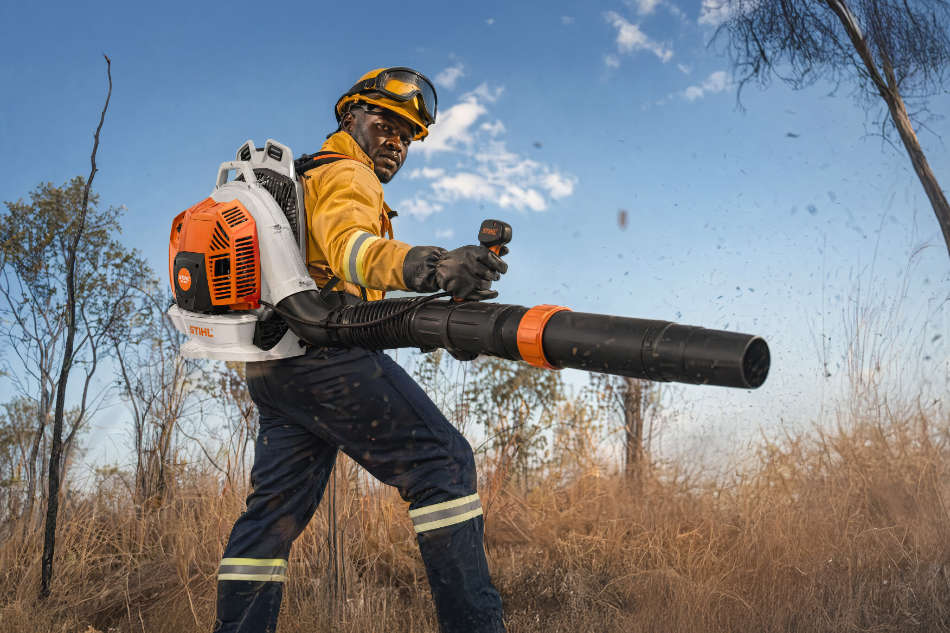
The BR range features anti-vibration systems and ergonomic harnesses to reduce operator fatigue.
When you need to slow or stop the spread of fire, you need to remove the fuel. This is where professionals rely on the STIHL BR range of backpack blowers to clear combustible material and create effective fire breaks.
To understand the role of a STIHL backpack blower in fire control, you first need to understand how fire spreads. Fire requires oxygen and fuel. In forestry environments, the forest floor is covered with a dense layer of dry needles, twigs, and leaf litter. This layer serves as a continuous fuel source, enabling fire to spread quickly and unpredictably.
Although often associated with general clearing, professional users recognise these machines as powerful tools for fuel management. The BR 600, BR 700, and BR 800 use high-velocity airflow to remove combustible material, exposing mineral soil and creating effective firebreaks.
This approach reflects STIHL’s long-standing commitment to engineering solutions that make working with nature more efficient. This philosophy continues to guide the brand as it marks 100 years of innovation.
Redefining fire breaks
In remote or rugged environments, where access to water is limited, prevention is the most effective form of control. Creating and maintaining firebreaks is essential, and the ability to do so quickly can make a significant difference.
Fire spreads when there is a continuous path of fuel. Breaking that continuity is key to controlling its spread; traditional methods often involve manual clearing, which is labour-intensive and time-consuming.
A high-performance blower enables operators to clear fine fuels efficiently, reducing the time and labour required compared with manual methods. Rather than relying solely on hand tools, teams can establish clean, consistent breaks more quickly and with less physical strain.
The STIHL BR 600 offers a more efficient alternative. Known for its strong power-to-weight ratio, it enables operators to work for longer periods while maintaining consistent performance. This makes it well-suited for clearing defined lines in challenging terrain. As the scale of the task increases, so does the need for higher output.
The BR 700 and BR 800
The STIHL BR 700 is designed for higher air volume, making it effective for moving heavier or more compacted debris. In fire management, this allows teams to widen existing firebreaks and clear dense fuel loads more quickly, improving overall site readiness.

The top of the range powerful BR 800 backpack blower.
The BR 800 represents the highest level of performance in the range. Built for demanding conditions, it delivers maximum blowing force for large-scale clearing. Its side-start feature allows the operator to restart the machine without removing it, reducing interruptions and helping maintain momentum during critical operations.
Together, these tools enable teams to match the right level of power to the task, improving both efficiency and effectiveness in the field.
Controlled burns
Beyond preparation, blowers can also support active fire control techniques. In controlled burns, managing the direction and intensity of flames is essential. The focused airflow from a backpack blower can help direct flames and clear residual fuel ahead of the burn line. This adds an extra level of control, helping teams to manage fire behaviour more safely and predictably.
Ergonomic design
Forestry and fire management often involve long hours in physically demanding environments, and equipment design plays a key role in maintaining operator performance.
The STIHL BR range features anti-vibration systems and ergonomic harnesses to reduce fatigue. By improving comfort and stability, these features help operators maintain consistent output over extended periods, which is essential in high-pressure situations.
Fire management
Effective fire management starts with preparation. Creating clean, reliable firebreaks and managing fuel loads are essential to reduce risk. Whether it is the balanced performance of the BR 600, the increased capacity of the BR 700, or the maximum output of the BR 800, each machine offers a practical way to improve efficiency in the field.
As fire seasons become more demanding, tools that enable faster clearing, reduce labour intensity, and offer greater control will continue to play a vital role in protecting both land and livelihoods. This ongoing focus on performance and reliability reflects a century of STIHL engineering dedicated to supporting professionals in the environments that matter most.
Read more – https://www.woodbizafrica.co.za/may-2026-issue-59/#may-2026-issue-59/20/”