



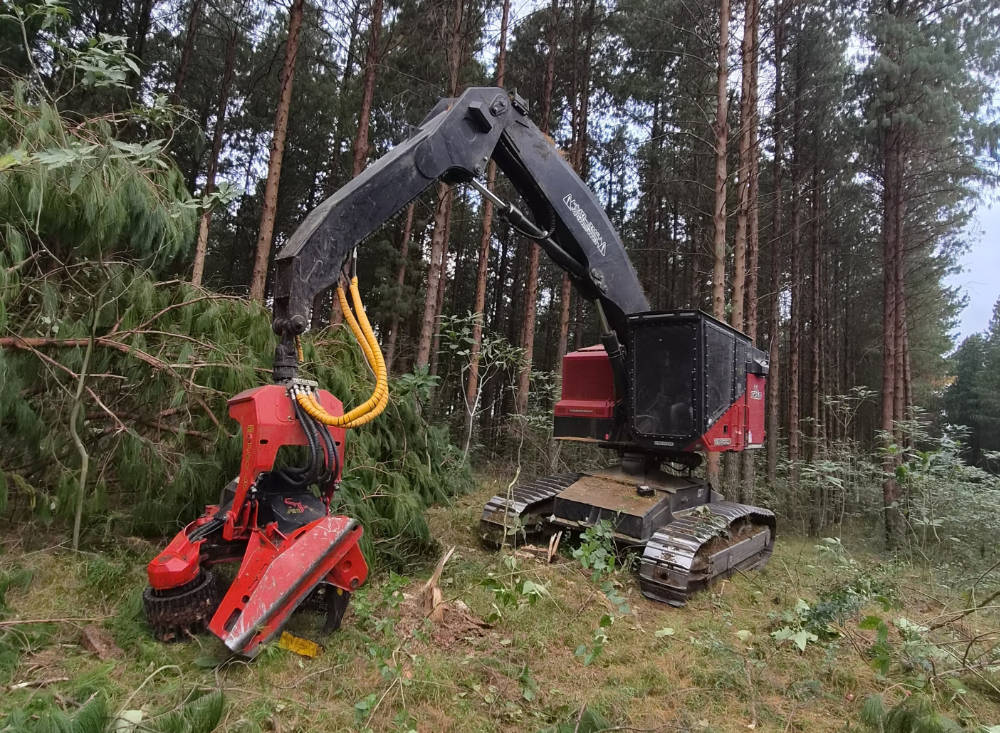
The TimberPro 725D and SP 761LF combination is proving to be an ideal solution for Mkhoba Forestry’s steep slope harvesting operations.
Harvesting and transport specialist Mkhoba Forestry has invested in the proven TimberPro 725D levelling harvester and SP Maskiner 761LF head combination to address steep-slope cut-to-length operations in south-western KwaZulu-Natal.
Mkhoba Forestry is based in Harding and is contracted by Merensky Timber’s Weza Sawmill in the Ugu District to harvest, extract and transport pine to the mill and to the port in Durban. Siyabonga Cosmos Shoba, managing director of Mkhoba, says they ordered the new TimberPro harvester from Logmech last year, with delivery this year. Logmech lent them an older machine for trial and operator training until the new machines arrived.
Shoba says it is a business imperative for the company to have a reliable harvester fitted with a robust head that measures and cuts accurately.
“We specialise in steep-slope harvesting, but our two Hitachi excavators are not well suited to working on slopes. We tried various combinations of carrier and harvesting heads before settling on the TimberPro 725D Leveller fitted with the SP761LF.”
“We also found that eucalyptus harvesting heads fitted with measuring in the arm motors are not ideal for pine stems because they cannot consistently deliver the accurate lengths we require. Our trials showed that the calibrated SP 761LF is the most accurate head for pine and best suited to the diameters we work with.”
The SP 761LF head
Ryan Chase, Logmech’s technical manager, says the SP 761LF is the largest head in the SP Maskiner range and is purpose-built for pine, although it can be converted to harvest eucs. Chase adds that the SP 761LF delivers peak performance on stands with a diameter of 20 to 56 cm; however, thanks to the LF system, it can cut larger diameters efficiently.
Unlike the design concept of a three-roller head, where the tree is held in the head by two outer arm rollers and a single centre roller, which closes onto the tree in a triangle configuration and fully supports the tree while it’s held in the head, the SP 761LF is a two-roller design, and there is no centre roller.
When the rollers close onto the tree, they clamp onto the sides, providing very good support compared with the three-roller design. The upper and lower delimb knives support and hold the tree in the head.
Another advantage of not having a centre roller is that, when the tree is held in the head, it maintains a gap between the tree and the chassis, so rubbing and friction between the tree and the chassis are kept to a minimum.
LF and LogHold features
The LF stands for low friction, and Chase says it’s achieved in two ways. An SP patent covers the head’s feed roller arm pin position. The pins are positioned in the chassis with a slight forward rake angle so that the feed rollers form a “V” configuration. When the feed rollers close onto the tree, they support most of the weight, allowing knife pressure to be reduced. This enables the knives to skim lightly along the tree, ultimately producing a higher-quality product.
A second SP patent is a feature known as LogHold. When the head is active, the system constantly monitors the delimb knife position. Trigger points can be set to determine how much the knives are allowed to open before it instantly corrects the knife positioning. It is all about automatic proportional pressure control on the delimbing knives and how tightly the knives hold the tree inside the head. Chase explains.

Siyabonga Cosmos Shoba of Mkhoba Forestry.
Cutting assortments
Shoba’s teams are prepared for all eventualities. Weza’s assortments vary widely, including saw logs for Weza, other sawmills in the area, and export-grade round wood. They sometimes include 2.4m and 2.5m logs for pulp customers.
The specifications are entered into the harvester’s onboard computer, which ensures each log is cut to value lists or preferred length/diameter definitions, thereby reducing waste and increasing profit per log. Shoba uses the Dasa 5 Bucking Prio C system. Chase says that although the touch-screen system is not Windows-based, it provides all the data needed to analyse their productivity.
The machine can handle up to nine assortments, enabling Shoba to run an entire harvesting operation. Although it can operate automatically, Shoba has opted for a quality-focused operator-assisted approach. When the head picks up and begins delimbing a tree, it sends the dimensions to the operator, who selects the required cutting pattern and stacking process.
The operator
“The machine tells the operator what it is cutting, and he makes the decisions”, Shoba says. “We are not running fully automatically because the system is too fast and the extraction teams would fall behind”.
He is impressed with his harvesting teams. “Harvesting looks easy when you see it happening, but it isn’t. We trained two operators from scratch on the TimberPro, and it took them about two months to learn the machine and the head. It is not easy to find people with the dexterity and spatial awareness to operate a harvester safely”.
The TimberPro 725D
Chase says tracked levellers are at home on steep slopes, and clients specify whether they want a fully specified automatically levelling machine or opt to level the machine manually.
Shoba has opted for the manual version, which means the operator monitors the inclinometers in the cab while climbing and navigating rocks and obstacles, and adjusts the cab to keep it stable and level. The cab position can be corrected by 24° forward, 7° rear, and 24° to each side, ensuring the operator can work in extreme conditions with a perfectly level cab.
Significantly, the 725D, like all TimberPros, is ROPS (roll-over protective structure) and FOPS (falling object protective structure) certified. Chase says these are critical safety systems that protect the operator should the machine roll over.
In addition, the cab has three emergency exits, air conditioning, a heated seat, and 30 mm-thick polycarbonate windscreen and windows to protect the operator in the event of a chain shot striking the windscreen.
-

- Merensky Timber has contracted Mkhoba Forestry to harvest 14,000m3 of cut to length pine saw logs a month.
-

- The proportionally angled feeder rollers of the SP head lessens friction.
-

- The TimberPro 725D levelling harvester has excellent lights for working at night.
Advantages of TimberPro
Chase says TimberPro harvesters are known for operating on steeper slopes than other machines, and he is proud that Logmech now supports 21 active machines in South Africa.
The D Series has the new 9-litre Cummins Tier 3 engine that works with South Africa’s diesel rather than the expensive Tier 4 or 5 engines specified for refined fuel in EU and US markets.
The TimberPro line, available in both tracked and wheeled machines, comes standard with 360˚ continuous rotation, allowing the operator to always face the line or the work. This feature also enables the operator to remove and stack timber from 360˚ around the machine, including the option to work over the front, sides and rear.
When it comes to maintenance, Shoba says there isn’t much to do at the end of each day. The TimberPro auto-greases, so they grease the few greasing points on the head, clean the inside of the cab and check the hydraulics and the cutter bar oil.
Chase says that the pins and bushes are over-engineered to reduce wear and tear. “Another reason our customers enjoy low maintenance costs is that we have had input into the design. We watch operations and listen to the contractors to see where improvements can be made”.
“When our customers encounter issues, we inform the relevant OEM and suggest design changes. In some cases, the OEM will design the upgrade and send us the parts”, he explains.
One of the biggest advantages for fleet owners is that the top ends of the TimberPro 725, 735, 745 and 840 all share the same specifications. Only the bottom differs, depending on the wheeled chassis or track frame size.
All parts are standard, which means there is commonality across the model ranges. This means a single service kit, engine, or hydraulic pump can be kept in the parts store, reducing parts holding and ultimately the financial risk of tying up capital in slow-moving, expensive parts.
Another great advantage of the Timberpro is its well-designed hydraulic system. Each function has its own dedicated hydraulic pump, so there is no drop in machine performance when multi-functioning. This is especially noticeable when handling large timber.
The D series Timberpro can track, swing, boom up, and operate the head with zero lag in any function, thanks to each function having its own dedicated hydraulic pump. The D series Timberpro, paired with the SP 761LF, guarantees peak performance while delivering a high-quality log.
Read more – https://www.woodbizafrica.co.za/june-2026-issue-60/#june-2026-issue-60/12/